
What is musique concrète? An introduction to composing with recorded sounds, from Pierre Schaeffer to the textures and field recordings of Blinded.
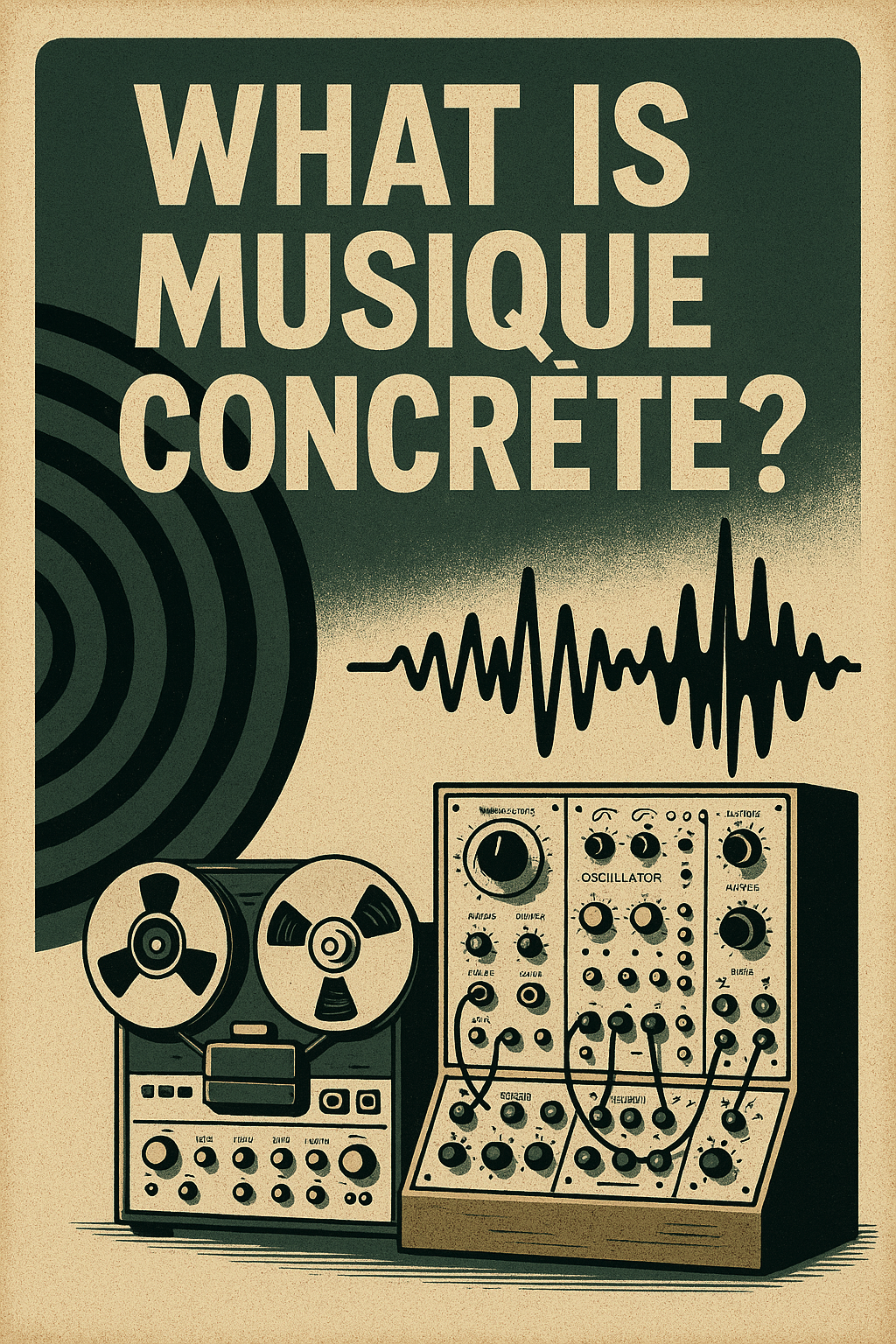
Imagine recording a train in 1948—not as background noise, but as material for a composition.
Not to transcribe it into notes on a staff, but to use that recording itself as the music. That’s exactly what Pierre Schaeffer, a French engineer and composer, decided to do—and in doing so, he cracked open a whole new world of sound.
Everyday sounds as instruments
In musique concrète, the raw material isn’t violins or pianos—it’s the world around us:
- a door creaking,
- footsteps echoing in a stairwell,
- church bells,
- the hum of your fridge.
These sounds are recorded, cut, slowed down, reversed, or layered until they become something else entirely. Suddenly, what used to be “noise” becomes music.
Why “concrète”?
Schaeffer called it “concrète” because he worked with concrete, real sounds, not abstract notes on a page. For him, the studio itself was the instrument. The tape machine, the splicer, the reverb chamber—this was the new orchestra.
The pioneers and beyond
After Schaeffer laid the foundations, a whole family of composers pushed musique concrète in different directions:
Pierre Henry (1927–2017) — often called the “father of electronic music,” he collaborated with Schaeffer and later created works like Variations pour une porte et un soupir, turning the creak of a door into an entire composition.
Luc Ferrari (1929–2005) — blended musique concrète with narrative and intimacy. His Presque rien No.1(1970) is literally a soundscape of a summer morning by the sea, almost documentary, but elevated into art.
Bernard Parmegiani (1927–2013) — a master of texture, whose De Natura Sonorum remains one of the richest explorations of sound material ever composed.
François Bayle (born in 1932) — developed the concept of “acousmatic music,” where sounds are heard without seeing their source, extending Schaeffer’s philosophy into immersive listening.
Iannis Xenakis (1922–2001) — though often seen as an avant-garde classical composer, he used tape and electronic processes that resonated with musique concrète’s spirit.
And then, in Lyon, the tradition continued:
Bernard Fort (born in 1954) — co-founder of the Groupe Musiques Vivantes, teacher, and composer who linked musique concrète with ornithology and soundscapes. His work often blends natural recordings (especially birdsong) with abstract structures. He also transmitted this legacy to new generations of composers.
Marc Favre — a French composer and sound designer, whose work explores the border between everyday sound, acousmatic art, and electroacoustic experimentation.
Together, they show how musique concrète didn’t stop with Schaeffer’s generation—it continues to evolve, adapt, and inspire.
Influence far beyond the avant-garde
Musique concrète didn’t stay locked in the studio—it bled into every corner of music:
Ambient & Drone: Brian Eno, William Basinski, Eliane Radigue, Murcof.
Electronic & Industrial: Aphex Twin, Autechre, SPK, Coil, Nurse With Wound.
Rock & Experimental: Pink Floyd (tape collages in Dark Side of the Moon), The Beatles (Revolution 9 is basically musique concrète), Frank Zappa.
Sound art & installations: Janet Cardiff, Christina Kubisch.
Pop culture: even mainstream producers sample and manipulate field recordings in ways that echo Schaeffer’s techniques.
In short: if you’ve ever heard a track that starts with rain, subway noise, or a distorted voice sample… you’ve heard the legacy of musique concrète.
How to listen
Musique concrète doesn’t hand you a melody to hum along to. Instead, it invites you to:
- sink into textures,
- notice rhythms hidden in chaos,
- and let your imagination paint the missing images.
Think of it like walking through a city with your eyes closed: you start hearing layers you normally ignore.
The ripple effect
This radical idea influenced not only avant-garde circles but also seeped into ambient, drone, electronic music, industrial soundscapes, and even pop sampling. Artists as diverse as William Basinski, Murcof, and The Residents echo its legacy in their own work.
A personal note
When I composed my album Blinded, I drew on this tradition. I let hiss, broken microphones, and environmental recordings shape the music just as much as instruments. Silence itself became a character. In that sense, Blinded owes a debt to musique concrète—it taught me that imperfection and rawness can be more expressive than polish.
Why it still matters
Because it changes the way you listen. Once you’ve stepped into musique concrète, the world is no longer just noise—it’s an endless symphony waiting to be heard.
Follow the sound
Continue with the everyday sounds behind Blinded and how to listen to experimental music.