
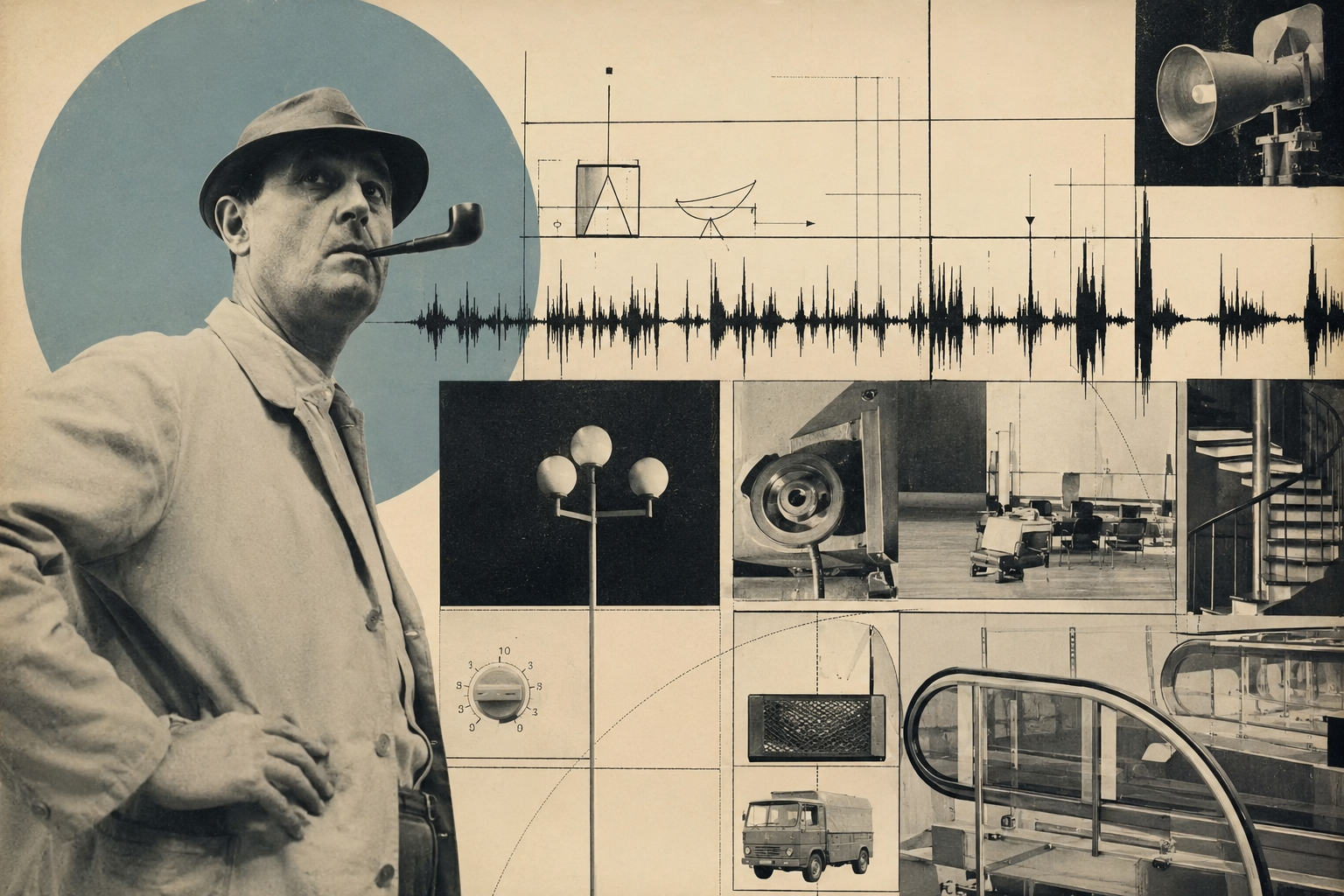
Jacques Tati is usually described as a master of visual comedy.
The description is accurate, but incomplete.
To watch Monsieur Hulot’s Holiday, Mon Oncle, PlayTime, or Trafic while concentrating on the soundtrack is to encounter an artist who thought about sound with the precision of a composer. Voices, footsteps, motors, doors, chairs, loudspeakers, kitchen appliances, fragments of popular music, and stretches of apparent silence are arranged into structures that determine how we perceive the image.
Tati did not merely add sound to his films.
He composed with it.
This does not mean that he should retrospectively be classified as a composer of musique concrète in the strict historical sense. That term belongs to a particular musical practice developed in France around Pierre Schaeffer from the late 1940s onward: music created from recorded sounds, subsequently selected, edited, repeated, transformed, and combined.
Tati was a filmmaker working with composers, sound recordists, editors, actors, objects, architecture, and recorded noise.
Yet the kinship is impossible to ignore.
In both Tati’s cinema and musique concrète, the ordinary sound is released from its ordinary function. A noise no longer merely confirms that a door has closed or a machine has started. It becomes a sonic object: isolated, exaggerated, displaced, repeated, and made available for a new kind of listening.
Tati’s soundtracks do not simply represent the world.
They reorganize it.
Music Beyond the Musical Score
Tati’s films contain real music, written by real composers.
Jean Yatove composed the music for Jour de fête. Alain Romans wrote the score for Monsieur Hulot’s Holiday and contributed, alongside Frank Barcellini, to Mon Oncle. The music of PlayTime is credited to Francis Lemarque and James Campbell, while Charles Dumont composed for Trafic and Parade.
These scores matter enormously.
The gentle main theme of Monsieur Hulot’s Holiday, for example, provides warmth and continuity. It evokes summer, memory, leisure, and the slightly melancholy awareness that holidays must end. Tati was not opposed to melody, nor did he seek to replace conventional music with noise.
What makes his work unique is that the distinction between score and soundscape becomes porous.
A musical theme may begin as accompaniment, while the noises of the environment gradually establish their own rhythm. A machine repeats a gesture until it behaves like percussion. Footsteps create a pulse. A car engine acquires a recognizable voice. Speech loses its dramatic authority and joins the acoustic background.
The soundtrack becomes musical even when no music is playing.
Tati encourages us to hear composition not only in melodies and harmonies, but in density, repetition, duration, distance, resonance, contrast, and timbre.
These are also the fundamental materials of electroacoustic music.
Dialogue Without Authority
In conventional narrative cinema, dialogue usually occupies the top of the sonic hierarchy.
The voices must be intelligible. Background sounds are reduced so that language remains clear. Music enters to support the emotional meaning of the words.
Tati overturns this hierarchy.
People speak constantly in his films, but their words are frequently banal, fragmentary, distant, multilingual, or dramatically irrelevant. Conversation becomes part of the environment: a human murmur comparable to traffic, ventilation, clinking glasses, or footsteps in a corridor.
This does not mean that Tati’s dialogue is carelessly recorded or simply unintelligible. André Bazin observed that Tati creates insignificance through extreme sonic precision: voices can be perfectly audible while conveying almost nothing of narrative importance. Sudden noises then emerge from this carefully constructed background with an exaggerated and sometimes absurd prominence.
The result is profoundly democratic.
A businessman’s announcement does not automatically matter more than a squeaking chair. A receptionist’s instructions may be less informative than the rhythm of approaching footsteps. A conversation taking place in the foreground may be acoustically displaced by an event occurring outside the frame.
Sound frees the viewer from the authority of dialogue.
We are invited to listen across the entire acoustic field, just as Tati’s wide compositions invite us to look beyond the apparent center of the image.
Monsieur Hulot’s Holiday: The Acoustic Life of a Seaside Hotel
In Monsieur Hulot’s Holiday, the Hôtel de la Plage is not simply a location.
It is an instrument.
Doors open and close. Shoes cross wooden floors. Cutlery punctuates meals. Voices drift through shared spaces. The sea provides a distant and irregular continuum. A loudspeaker at the railway station transforms language into an incomprehensible mechanical announcement. The hotel guests generate a collective soundscape without ever becoming a conventional chorus.
Hulot’s arrival introduces a particularly memorable sonic character: his old car.
Tati later explained that the car’s engine sound was as important as its physical appearance. Even before the vehicle enters the frame, its motor announces its approach and establishes its personality.
This is a crucial idea.
The car is not accompanied by a comic noise. The noise is part of the character.
The same principle applies throughout Tati’s work. Objects possess acoustic identities. Their sounds communicate age, material, social status, efficiency, fragility, and temperament. A modern object may emit a smooth pneumatic sigh; an older machine may cough, rattle, and protest.
Tati listens to objects as though they were performers.
The famous offscreen Ping-Pong game offers another example. Its repeated impacts acquire disproportionate prominence, interrupting the quieter activities of the hotel guests. The source of the noise is mundane, but its persistence transforms it into a rhythmic intrusion.
A ball striking a table becomes a compositional event.
Mon Oncle: Two Worlds, Two Soundscapes
Mon Oncle develops Tati’s musical organization of sound through contrast.
The old neighborhood inhabited by Hulot is acoustically irregular. It contains voices, animals, street activity, footsteps, vendors, children, and sounds whose origins may not be immediately visible. Its rhythm is loose, layered, and unpredictable.
The modern Villa Arpel operates according to another acoustic logic.
Its spaces are defined by hard surfaces, electric mechanisms, switches, pipes, appliances, doors, and carefully managed domestic technology. The house announces its supposed efficiency through sound, but every mechanical gesture also reveals effort, anxiety, and absurdity.
The architecture seems to demand a corresponding style of listening.
In the old neighborhood, sounds overlap and coexist.
At the Arpels’, sounds isolate themselves.
A button is pressed.
A mechanism responds.
A visitor arrives.
The fountain is activated.
A device performs its function with excessive acoustic importance.
The difference is not simply between a warm past and a cold future. Tati’s relationship with modern technology is far more ambivalent. He is fascinated by design, automation, novelty, and spectacle. His comedy emerges not because machines are inherently evil, but because humans reorganize their behavior around them.
Sound makes this reorganization audible.
The modern home resembles a primitive electronic composition: impulses trigger responses, materials resonate, actions repeat, and the human body becomes one component in a larger mechanical system.
The result is both funny and strangely musical.
PlayTime: Architecture Becomes an Orchestra
In PlayTime, Tati’s acoustic imagination reaches its most complete form.
The film’s modern city is built from glass, metal, polished floors, artificial lighting, office furniture, public-address systems, automobiles, elevators, doors, exhibition stands, and ventilation systems. Each material possesses a potential sound, and every space changes the way that sound is perceived.
The opening sections are dominated by acoustic restraint.
Footsteps echo through spaces that initially resemble a hospital, an airport, and an office complex almost simultaneously. Voices are dispersed rather than centralized. Machines hum discreetly. Hard heels mark the floor with unnatural clarity.
The architecture appears to produce its own soundtrack.
Tati’s modern chairs offer one of the film’s most perfect sound-image combinations. When a person sits down, the cushions compress with a prolonged pneumatic exhalation. When the person stands, the material slowly recovers its shape, accompanied by another artificial breath. Tati himself emphasized that the sound of the chair was as significant as its visual design.
The chair becomes an animal, a machine, and a musical phrase.
Its sound has an attack, a duration, a changing texture, and a release.
This is precisely how an electroacoustic composer might approach recorded material: not primarily by asking what produced the sound, but by listening to its internal shape.
Sound as a Guide for the Eye
Because PlayTime frequently presents several actions within the same wide frame, the viewer cannot watch everything at once.
Sound helps direct attention.
A sudden impact may draw the eye toward the edge of the image. A mechanical noise may announce an event before its source becomes visible. A rhythm may establish a pattern that allows us to anticipate its disruption. An offscreen sound may suggest a space extending beyond the limits of the frame.
Tati’s sound is therefore not merely synchronized with the image.
It choreographs our act of looking.
Accounts of his studio practice describe the extraordinary effort devoted to apparently minor effects. To create the sound of a waiter’s trousers splitting in PlayTime, different materials were reportedly torn until the precise noise was found. Tati sometimes also used his own voice as raw material for effects.
The objective was not documentary accuracy.
The “correct” sound was the one that completed the visual gesture.
This distinction is fundamental. Sound design is not obliged to reproduce what an object would literally sound like. It can reveal what the object feels like, what it means within the scene, or how it alters the rhythm of the film.
Tati’s sounds are credible without always being realistic.
They belong to a world reconstructed by listening.
The Royal Garden: From Noise to Music
The Royal Garden sequence in PlayTime is one of cinema’s great audiovisual compositions.
The restaurant opens before it is ready. Materials break, clothing tears, tiles stick to shoes, chairs leave marks on customers, doors malfunction, and the supposedly elegant environment begins to disintegrate.
At first, every failure appears isolated.
A small accident.
A defective object.
An awkward interaction.
Gradually, these separate events begin to connect.
Repetition creates expectation. Sounds answer one another across the room. Gestures become rhythmic. The crowd thickens. Fragments of music emerge. The rigid geometry of the restaurant loosens, and the scene moves toward collective dance.
Tati spent weeks constructing the sequence, organizing separate actions across foreground and background while observing the complete frame.
The musical transformation is not limited to the musicians inside the restaurant.
The whole space becomes music.
Impacts function as percussion.
Voices become texture.
Movement becomes phrasing.
Architectural collapse produces syncopation.
The restaurant initially promises control: fixed tables, straight lines, formal service, and carefully separated social roles. By morning, it has become an improvised community held together by rhythm.
Sound does not merely accompany this liberation.
Sound creates it.
Trafic: The Mechanical Body
In Trafic, the automobile becomes Tati’s principal sound source.
Engines accelerate, idle, cough, and stall. Horns signal impatience or identity. Doors close with different degrees of authority. Windscreen wipers move in repetitive patterns. Traffic creates dense and fluctuating layers of mechanical noise.
Once again, no two machines seem acoustically identical.
The vehicles behave like bodies, while the bodies inside them begin to behave like machines.
Tati was interested in the way driving alters human personality and in the diminishing role of bodily participation as automobiles become increasingly automated. He recalled that drivers once listened closely to the motor in order to know when to change gear.
Driving was partly an act of listening.
In Trafic, that relationship has become distorted. The modern road produces enormous quantities of sound, but relatively little communication. Cars move, stop, queue, collide, and become immobilized within systems supposedly designed for mobility.
The pileup sequence is particularly striking. The crash is not treated as a single violent event. It unfolds as a choreography of vehicles, bodies, gestures, impacts, and mechanical aftereffects. Cause and consequence dissolve into a series of movements that seem simultaneously accidental and composed.
Tati turns traffic into percussion theatre.
The Studio as an Instrument
Tati’s soundtracks feel so attentive to the physical world that it is tempting to imagine them as documentary recordings captured during filming.
In reality, his approach was highly constructed.
Tati explained that he generally filmed without recording the final production sound, partly because he needed to speak constantly to actors, nonprofessional performers, and animals during a take. The soundtrack could then be built separately.
This method gave him extraordinary freedom.
He could alter perspective.
He could replace a literal sound with a more expressive one.
He could make a distant object acoustically prominent.
He could remove sounds that would normally be present.
He could extend an offscreen noise into another shot.
He could combine realism and abstraction without drawing attention to the transition.
The studio became an instrument for recomposing reality.
This places Tati close to the central intuition of musique concrète: recording is not merely a means of preserving an event. It creates material that can be selected, isolated, reorganized, and heard differently.
Yet Tati’s purpose remained cinematic.
His sounds preserve a relationship with bodies, objects, architecture, and social behavior. Even when their scale or placement is impossible, they remain connected to a visible or imaginable world.
The sound object never completely abandons the story of its source.
Instead, it reveals that source anew.
An Electroacoustic Cinema—With an Important Qualification
Calling Tati an electroacoustic composer is useful only if we understand the phrase metaphorically.
He was not working inside the studios, institutions, theories, or concert traditions associated with Pierre Schaeffer, Pierre Henry, or the Groupe de recherches musicales. There is no need to invent a direct affiliation.
The deeper connection lies in practice.
Tati and the pioneers of musique concrète shared a belief—whether articulated in the same terms or not—that recorded reality could become compositional material.
A train is not only transportation.
A door is not only architecture.
A human voice is not only language.
A chair is not only furniture.
Once recorded, each can be heard as rhythm, timbre, mass, contour, texture, repetition, or interruption.
Tati’s cinema adds another dimension to this idea.
He restores the sound to the visible world while allowing us to hear it as though it had become strange.
This double perception is central to his art.
We recognize the object, but we hear it differently.
We understand the situation, but the soundtrack exposes its absurdity.
We inhabit an ordinary environment, but every sound appears newly significant.
Tati once observed that natural sounds seem louder when people find themselves in unfamiliar surroundings. His films achieve something similar by making familiar surroundings acoustically unfamiliar.
He turns everyday life into a foreign country for the ear.
Silence Is Never Empty
Tati is often described as a nearly silent filmmaker.
That description can be misleading.
His films are rarely silent. They are filled with low-level activity: distant voices, room tone, footsteps, wind, motors, public announcements, birds, traffic, music heard from another space, and sounds whose source remains outside the frame.
What disappears is not sound.
What disappears is the conventional hierarchy that tells us which sounds matter.
By reducing dialogue and avoiding continuous emotional underscoring, Tati creates space around individual sonic events. A small noise can suddenly alter the balance of an entire scene.
Silence, in this context, is not the absence of acoustic information.
It is a condition of heightened attention.
The fewer instructions we receive, the more carefully we listen.
Humor as a Form of Listening
Tati’s comedy is often described as observational, but observation is not exclusively visual.
Many of his jokes begin when a sound contradicts an appearance.
An elegant object emits an undignified noise.
A technologically advanced machine produces a primitive rhythm.
A tiny gesture receives an absurdly large acoustic consequence.
A distant sound appears closer than the person producing it.
An offscreen object develops a personality before we see it.
These discrepancies make us laugh because they reveal that the world is less stable than it appears.
Sound dismantles appearances.
It exposes the physical truth hidden beneath design, etiquette, architecture, and social performance.
The polished surface squeaks.
The modern chair gasps.
The efficient machine stutters.
The sophisticated restaurant collapses into rhythm.
Tati’s humor is therefore not based only on what people do.
It emerges from listening to what the world does in response.
What Tati Teaches a Composer
For composers working with field recordings, processed sound, electroacoustic textures, ambient space, or unconventional timbres, Tati offers lessons that extend far beyond cinema.
The first is that recognition can be more powerful than novelty.
A completely synthetic sound may intrigue us, but a familiar sound heard from an unfamiliar perspective can disturb memory, awaken emotion, or transform our perception of a space.
The second is that every sound carries social information.
A machine does not simply have a timbre. It belongs to a period, a class, an environment, and an idea of progress. A voice communicates status and attitude before its words are understood. Reverberation reveals architecture. Mechanical regularity can suggest control, while acoustic irregularity can suggest life.
The third lesson is restraint.
Tati does not make every sound extraordinary. His strongest effects emerge because they are surrounded by quieter, less assertive material.
Composition depends on hierarchy.
If everything is emphasized, nothing can surprise us.
Finally, Tati demonstrates that sound does not have to explain an image.
It can oppose it, enlarge it, mock it, destabilize it, or reveal something occurring beyond its boundaries.
Image and sound do not need to say the same thing.
Their disagreement may be where the work begins.
How Jacques Tati Shaped My Own Approach to Sound
I did not immediately recognize Jacques Tati’s influence on my own music.
It emerged gradually.
Like many composers, I once thought principally in terms of harmony, melody, instrumentation, and musical development. Over time, I became increasingly drawn to what exists around and between those elements: resonance, deterioration, distance, breath, texture, silence, and the acoustic identity of places and objects.
In my own work, including Blinded, sound is rarely decorative.
A noise, a resonance, or a fragment of acoustic space may carry as much emotional weight as a chord. I am interested in sounds that seem to remember where they came from while no longer belonging entirely to that place.
That is one reason Tati remains so important to me.
His films show that experimentation does not require us to abandon the everyday world. On the contrary, it may require us to listen to that world more closely.
A motor can become a character.
A room can become an instrument.
A repeated gesture can become an ostinato.
A mechanical fault can become syncopation.
An empty space can acquire a pitch, a density, and a duration.
Tati also reminds me that complexity does not need to announce itself. His soundtracks are extraordinarily constructed, yet they rarely display their technique. They remain playful, immediate, and accessible.
The craft disappears inside the act of listening.
That is perhaps the most difficult balance to achieve: creating a highly composed sonic world that still appears alive, accidental, and open to discovery.
Learning to Hear the Ordinary Again
Jacques Tati’s films changed the possibilities of cinematic sound not by making it larger, louder, or more spectacular, but by making it more attentive.
He listened to the overlooked.
To materials.
To distances.
To awkward mechanisms.
To the rhythm of social behavior.
To the acoustic life of objects.
He understood that recorded sound could be realistic and artificial at the same time. It could describe a world while quietly recomposing it. It could guide the eye, create comedy, reveal architecture, and transform a collection of ordinary actions into music.
Tati may not have been a composer of musique concrète in the historical sense.
But his cinema asks a profoundly electroacoustic question:
What happens when we stop dividing the world into music and noise?
Once that division disappears, the city becomes an orchestra.
Machines acquire voices.
Architecture begins to resonate.
Everyday gestures become rhythm.
And listening itself becomes an act of composition.